Cracked or Slipping Roof Tiles on a South Florida Home? Why It Happens
October 15, 2026
QUICK ANSWER: Roof tiles crack and slip in South Florida for a handful of repeatable reasons: wind and flying debris during storms, daily heat cycling that stresses rigid tile, foot traffic from other trades, aging fasteners and adhesive, and a failing layer underneath that lets tiles settle out of position. The tile you can see is only part of the story. A single cracked or shifted tile can be an isolated hit from a falling branch, or it can be the first visible sign that the system beneath is moving. Knowing which one you have starts with where the damaged tiles are, how many there are, and whether the pattern follows the weather or follows the roof.
You were out getting the mail when you noticed it. A curved piece of tile on the driveway, orange or gray depending on your roof, with a fresh broken edge. Or maybe you looked up from the pool and saw one tile sitting a little crooked, tilted away from the row beside it, with a thin dark gap showing underneath. The last storm was a week ago and nothing leaked, so you told yourself it was probably nothing.
It might be nothing. Tile roofs are tough, and a single chipped tile does not mean your roof is failing. But tiles do not crack or slide for no reason, and the reason matters. Here is what actually breaks and moves tiles on South Florida homes, how to read the pattern you are looking at, and how to tell a one time hit from a roof that is telling you something.
A tile roof is two systems, and only one of them is visible.
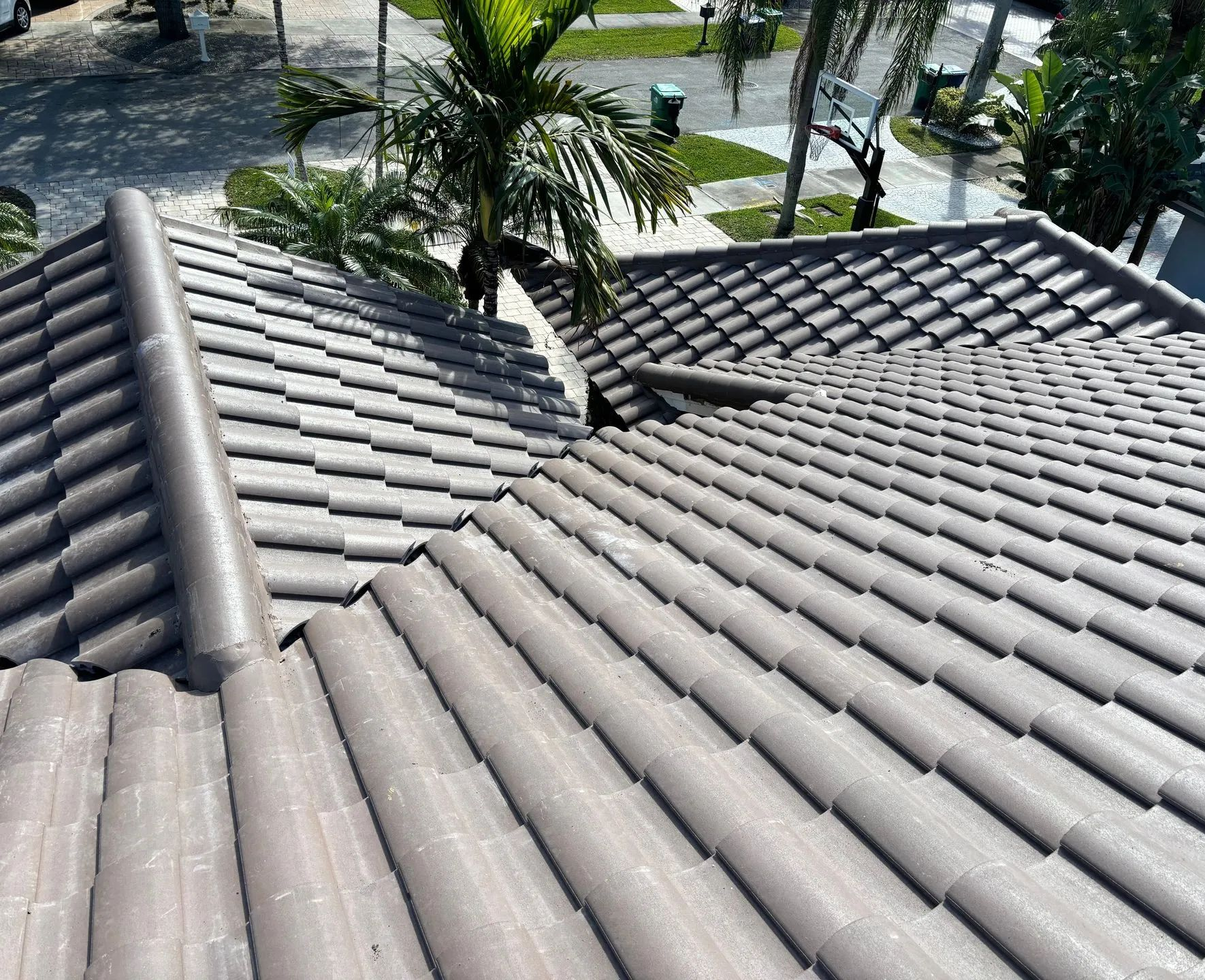
When people say tile roof, they picture the tiles. Clay or concrete, barrel or flat, they are the part you see and the part that gets compliments. But the tiles are mostly a heavy, durable outer shell. They shed the bulk of the rain and they take the sun, and they add a lot of wind resistance when they are secured properly. What they are not is the waterproof barrier.
The waterproofing is the underlayment, a membrane fastened to the roof deck beneath the tile. Tiles are held in place by fasteners, mortar, or foam adhesive depending on how the roof was built, and every one of those attachments relies on the layers below staying put. That is why a tile problem is rarely only a tile problem. When a tile cracks, you have lost a piece of the shell. When a tile slips, you may have lost the attachment that held it, and in either case the underlayment is now more exposed than it was designed to be.
Storm wind and flying debris do most of the dramatic damage.
South Florida roofs take hard wind a few times a year, and tile is both strong and unforgiving. A rigid tile does not flex under impact the way a shingle does. When a palm frond, a tree limb, or a piece of someone else's fence hits it at speed, the tile tends to crack or snap rather than dent.
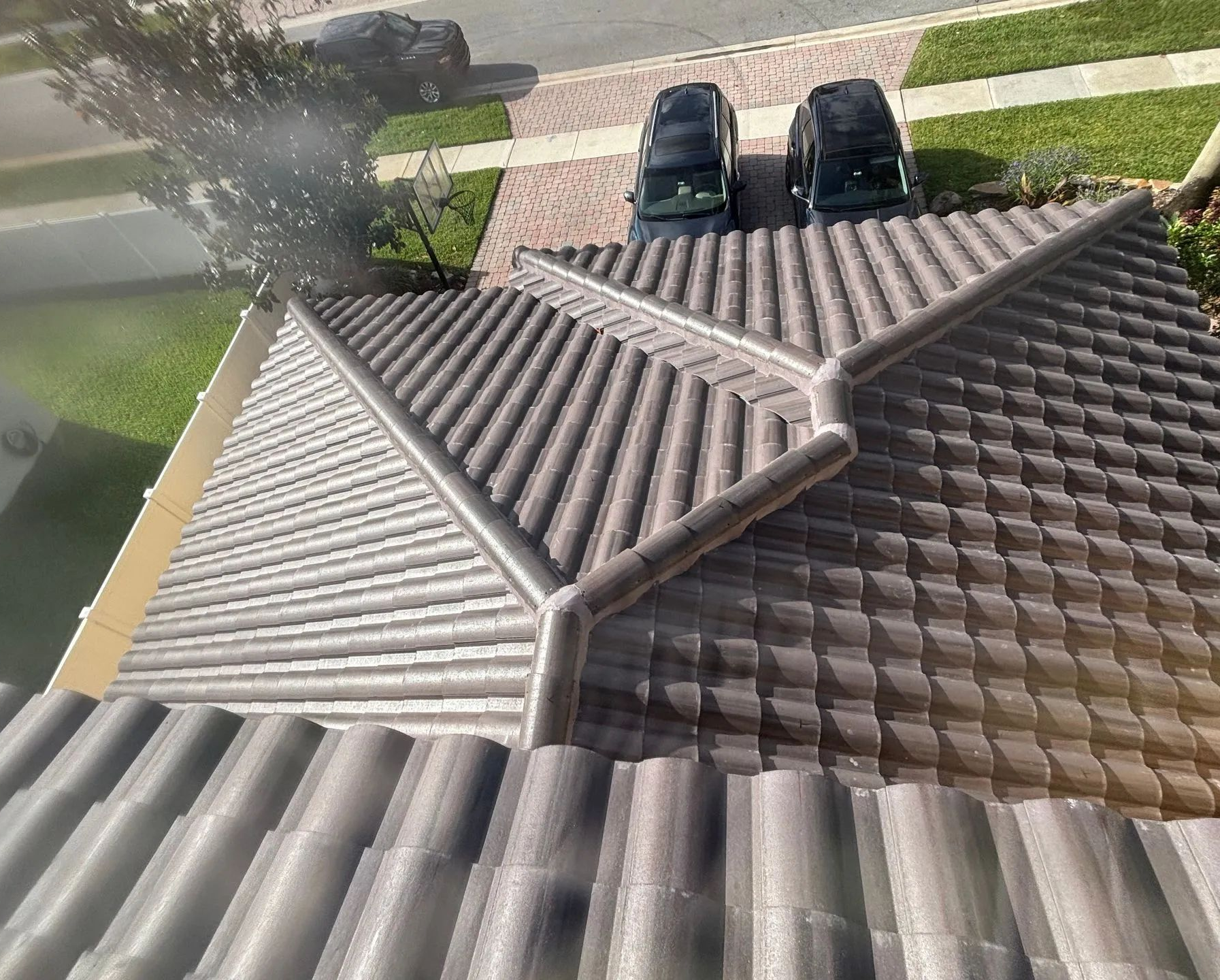
Wind also does its work without anything hitting the roof. Gusts get under tiles at the edges, ridges, and corners, where the roof sees the highest uplift pressure. Tiles that were marginally attached, or whose attachment has aged, can lift and shift out of line or break loose entirely. This is why storm damage tends to show up first along the perimeter, at the hips and ridges, and at the lower edge of each slope.
If you find damaged tiles clustered in those edge zones after a storm, wind is the likely cause. If you find damage spread across the middle of a slope with no storm to explain it, something else is going on.
Heat cycling works on tile every single day.
A South Florida roof surface can get far hotter than the air around it on a summer afternoon, then cool quickly when a thunderstorm rolls through. That swing happens over and over, season after season. Concrete and clay both expand and contract with temperature, and a rigid material that is held in place at fixed points has nowhere to put that movement.
The result is slow fatigue. Hairline cracks develop at stress points, usually near fasteners, at overlaps, and along the edges of cut tiles. They are easy to miss from the ground. Then a heavy rain gets into the crack, or a day of intense sun widens it, and one morning you find the tile in two pieces. A tile that breaks on a perfectly calm day is often a tile that had been cracked for a long while.
The same movement can also work against whatever is holding tiles down. Mortar can crack and crumble, especially at ridges and hips, and foam adhesive can lose its grip as it ages and gets repeatedly flexed by heat.
Foot traffic is the damage nobody mentions.
Tile is strong when it is loaded the right way and fragile when it is not. Weight placed on the wrong part of a tile, especially between supports, can snap it. A great many cracked tiles on South Florida roofs were not broken by a storm at all. They were broken by someone walking on the roof.
That someone is often a technician. The person who cleans the gutters, the crew that paints or pressure washes the roof, the installer who mounts an antenna or a satellite dish, the pool or solar contractor who needed access, the tree trimmer who climbed up to retrieve a limb. Any of them can crack tiles without realizing it, and the damage often does not announce itself until the next heavy rain.
If your cracked tiles show up in a line or a path, especially from the edge toward a vent, a chimney, or an equipment pad, a walking pattern is a strong suspect.
TIP: After anyone works on or near your roof, take a few minutes the next day to scan it from the ground with binoculars. Look for fresh cracks, pieces missing from an edge, and tiles sitting out of line. A broken tile caught the day after the work is much easier to trace than one found after the next storm.
Why tiles slip instead of cracking.
A slipped tile is a different problem than a cracked one. A crack is a failure of the tile itself. A slip is a failure of what was holding it, and it usually has one of a few causes.
Fasteners can back out or corrode. Salt air along the coast and the constant humidity inland are hard on metal, and a fastener that has loosened or rusted will stop holding the tile against the roof. Mortar or foam adhesive can age out, which lets tiles creep, particularly on steeper slopes. The tiles above a damaged one can also shift downhill if the one below has lost its support, so that one problem becomes three crooked tiles in a row.
Underlayment matters here too. As the underlayment beneath tiles ages, it can become brittle and distorted, and the surface the tiles sit on is no longer the flat, even plane it was at installation. That uneven support puts uneven stress on rigid tiles, which is a reason you sometimes see both slipping and cracking on the same older roof.
A slipped tile also leaves a gap. Water that would normally shed off the surface can run through the opening and land directly on underlayment that was never meant to carry the full load.
The pattern tells you more than any single tile.
When you walk around your property looking up, count what you see and note where it is. That pattern is the most useful information you can bring to a roofer.
One or two damaged tiles near an edge after a storm usually point to a local event: debris, a gust, or a branch. A cluster of damage along a single slope facing the prevailing wind points to uplift at that exposure. Cracks scattered across the whole roof with no storm to explain them point to age, heat fatigue, or a material issue. A line of damage running between two places someone needed access suggests foot traffic. Slipped tiles concentrated at the ridge or at the hips often mean the mortar or adhesive there has given up.
None of these patterns are conclusive from the ground, but each one narrows the question. Take a few photos with your phone, zoomed in if you can, and note the date. Those photos let a roofer compare what you saw to what is actually up there.
What a cracked tile means for the layer underneath.
This is the part most homeowners are not told. A cracked tile is not automatically a leak, because the underlayment is designed to handle water that gets past the tile. But the underlayment is not meant to carry that load indefinitely, and it is not meant to sit exposed in the sun.
Every damaged or missing tile puts more demand on that layer. Over a single season, a few cracks may do no harm. Over several seasons, with daily sun on exposed membrane and heavy afternoon downpours funneling through small openings, the underlayment can degrade, stain, or fail at the seams. By the time a ceiling stain appears inside the house, the damage underneath has usually been developing for a while.
This is also why the question of how many tiles are damaged matters. A small number of isolated breaks is routine maintenance. Widespread cracking, or damage that keeps returning in the same area, suggests the roof is under stress that replacing tiles one at a time will not solve.
Why you cannot read this from the driveway.
Tile roofs have a way of looking fine from the ground. The color is even, the lines are clean, and the damage that matters most sits in the shadows between tiles and under the edges, where the eye does not go. Even a careful homeowner with binoculars can miss hairline cracks, tiles that have lifted slightly without shifting, and fasteners that have backed out.
A proper evaluation covers the whole roof, slope by slope. It includes checking how securely tiles are attached, looking at the condition of mortar at hips and ridges, inspecting flashing at penetrations and walls, and examining how the underlayment is holding up wherever tiles have been removed or are damaged. It often includes the attic, where water staining on the underside of the deck can show that moisture has been getting in even when nothing has dripped through a ceiling.
WARNING: Do not climb onto a tile roof to inspect it or to push a crooked tile back into place. Tile is slick, uneven, and easy to break underfoot, and walking on it is exactly how new cracks are made. Falls from roofs are also a serious injury risk. Stay on the ground with binoculars or a phone zoom, and leave the roof surface to someone equipped to work on it safely.
Replacing a tile is easy to say and harder to do well.
It sounds like the simplest repair in roofing: take out the bad tile, slide in a new one. In practice, a proper tile repair has several parts. The replacement needs to match the existing tile closely in profile, size, and color, which can be difficult on a roof that has weathered for years. The attachment needs to be done correctly for the roof's design and its wind requirements. And the underlayment beneath the damaged area needs to be checked and repaired if it has been compromised.
Skipping that last step is how a repaired roof ends up leaking anyway. A new tile on top of damaged underlayment hides the problem rather than fixing it. This is the main reason a quick patch by someone who only looks at the tile does not always hold.
Frequently Asked Questions
Is one cracked tile a reason to worry?
Usually not alone, but it deserves a look. A crack from a known event like a fallen branch is routine, while unexplained or clustered damage needs a closer check beneath.
Why would a tile slip when the roof is only a few years old?
Slipping points to attachment, not age. Poorly seated fasteners, weak mortar or adhesive bonds, or deck movement can shift tiles early, and storm uplift can move marginally secured ones.
Can heat alone crack roof tiles?
It contributes. Repeated heating and cooling stresses rigid tile, starting cracks at fasteners and edges. Heat rarely acts alone, but it weakens tile so impact or wind finishes the job.
Should I replace a broken tile myself?
No. Walking on the roof is a common way tiles break, and poorly attached replacements loosen in storms. You also cannot judge the underlayment without lifting surrounding tiles.
Do cracked tiles always mean there is a leak?
No. Underlayment handles water that slips past tiles, so many cracked roofs stay dry. The long term concern is that layer wearing down with each storm.
How soon after a storm should I check the roof?
As soon as it is safe, from the ground. Look for tile pieces in the yard, gaps, or crooked rows, and check the attic for stains or damp insulation.
What a Broken Tile Is Telling You
A broken or crooked tile is useful information. The better question is not whether a tile failed but why it failed, and whether the layers beneath the visible surface are still doing their jobs. Debris, heat, foot traffic, aging attachments, and a tired underlayment each leave a different pattern. Reading that pattern early is far easier than reading the water stain that follows, and it keeps a small repair from growing into a larger one.
Century Roofing Inc
has worked on
tile roofs
in Sunrise, FL for 30+ years, and that history shows in how a damaged roof is read. Looking at how tiles are attached, how the mortar is holding at the hips and ridges, and how the underlayment has aged helps separate a one-time hit from a roof under real stress. With that clarity, repairs address the cause as well as the visible piece, and the roof stays dependable through each storm season.